How to repot a dracaena: signs it is root-bound, pot size, a mix that drains and spares the fluoride-sensitive leaves, steps for tall plants, and top-dressing.
6 Updated October 15, 2026
By the FloraFact editorial team · How we researchPublished October 15, 2026 · Updated October 15, 2026
How often
Every 2-3 years; top-dress yearly
Best time
Spring to early summer
Pot
1-2 in wider, heavy for tall canes, drainage hole
Mix
Peat/coir mix + bark, little or no perlite
Soil pH
6.0-6.5
Pets
Toxic to dogs, cats, horses (ASPCA)
Repot a dracaena every 2-3 years in spring, moving it into a pot just 1-2 in wider with a drainage hole and a peat- or coir-based mix opened up with bark. Big floor-size plants can stay in the same container for years if you replace the top couple of inches of mix each spring.
Dracaenas - corn plant (Dracaena fragrans), Madagascar dragon tree (D. marginata), 'Janet Craig', 'Warneckii' - are slow, tough plants with two weak points that repotting can make better or worse: wet roots and fluoride.
Signs your dracaena needs repotting
Roots circling the bottom of the root ball or growing out of the drainage hole.
Water pours straight through, or the mix dries out within 2-3 days in a pot that used to stay moist for a week.
New leaves are getting smaller and the plant has not grown in a full spring and summer.
The plant is top-heavy and tips over.
A crust of white salt on the mix surface or pot rim.
Rot: soft cane base, sour smell, lower leaves yellowing quickly while the soil is wet. Repot now, whatever the season.
Brown leaf tips alone are not a reason to repot; they are usually a water-quality or humidity problem, covered in brown tips.
When to repot
Spring to early summer. The RHS dracaena growing guide advises repotting in spring when the roots become overcrowded. In a US home with central heating and short winter days, dracaena roots barely grow from November to February, so a fall repot leaves a lot of fresh mix wet for months.
Pot size and type
The RHS says move into a slightly larger container and avoid a much larger one. Practically:
Current pot
New pot
6 in
8 in
8 in
10 in
10-12 in
12-14 in
14 in and up
Same pot, root-prune or top-dress
Choose a drainage hole every time. For a 4-6 ft multi-cane corn plant or marginata, use a heavy ceramic or concrete pot with a wide base so it does not topple; a plastic grow pot inside a heavy cachepot also works.
The right potting mix
Dracaenas want a mix that holds some moisture but drains quickly. The RHS recommends roughly three parts peat-free ericaceous (acidic) compost, one part perlite and one part orchid bark. For US shoppers, a close equivalent is a standard bagged indoor potting mix with about a quarter orchid bark mixed in.
There is one dracaena-specific twist. Clemson Cooperative Extension notes that dracaenas are very sensitive to fluoride and advises avoiding potting soils high in perlite, keeping soil pH at 6.0-6.5, and skipping fertilizers containing superphosphate. Some perlite can release fluoride, so if your plant already gets brown tips, favor bark or coarse coir over perlite for drainage. Don't add lime or dolomite unless a test shows very acidic mix. More on mixes: potting soil for houseplants.
How to repot a dracaena, step by step
Water the day before so the root ball is evenly moist and holds together.
Lay the pot on its side on a tarp or newspaper. For tall canes, have a helper hold the canopy. Squeeze or tap the pot and slide the plant out by the base of the canes; never pull by the leaves.
Check the roots.
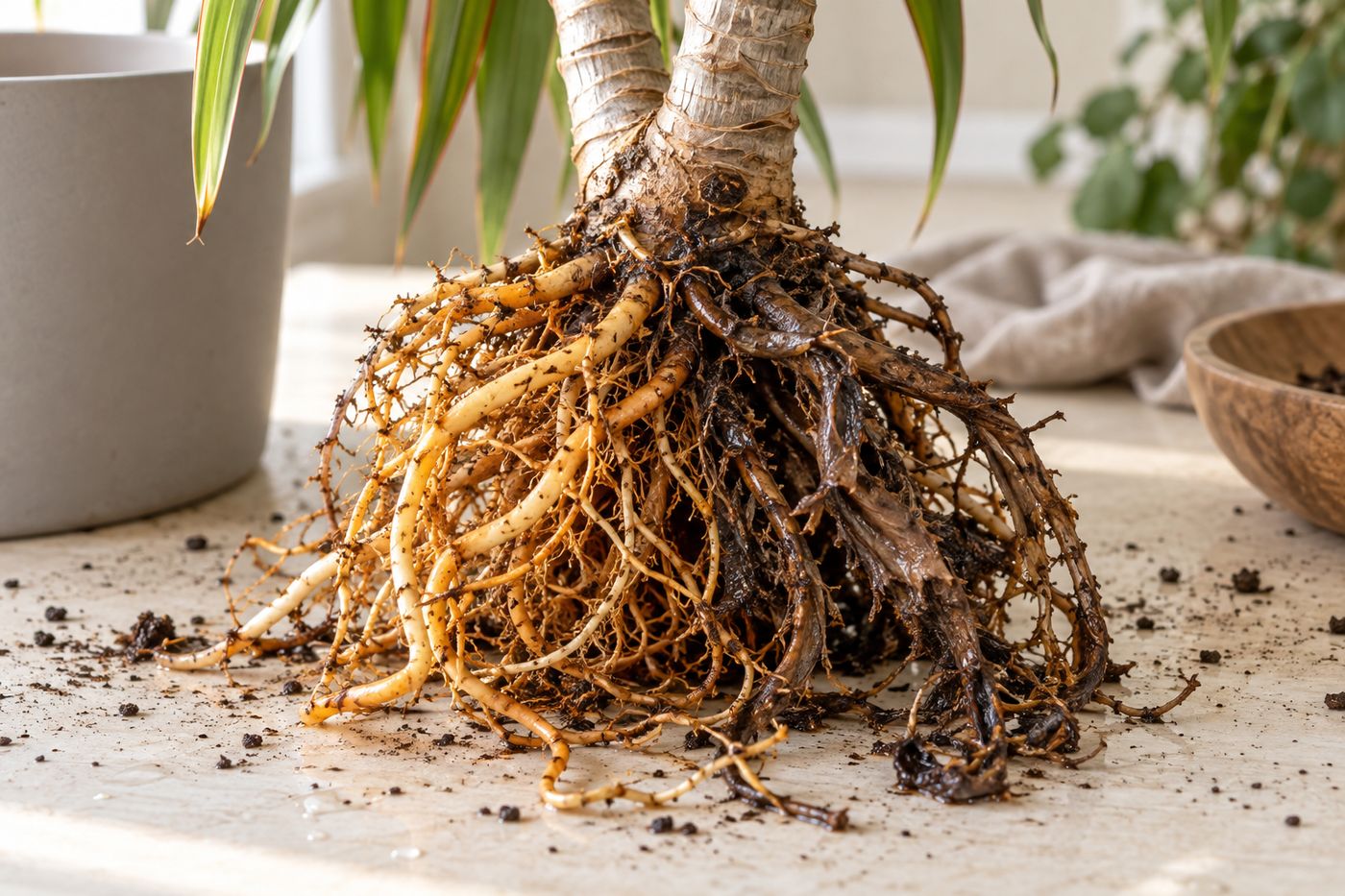
Healthy dracaena roots are firm and orange to yellow. Cut off dark brown, mushy roots whose outer layer slides off.
Loosen circling roots with your fingers, or score the outside of a tight root mat in 3-4 places.
Add mix to the new pot so the root ball top sits 1 in below the rim, at the same depth as before. Burying the canes deeper invites cane rot.
Fill the sides with fresh mix, firming lightly so tall canes stand straight.
Water thoroughly with room-temperature water until it drains; empty the saucer.
Top-dressing big plants
For a plant too large to repot, or already in a 14 in pot or larger, refresh the mix each spring instead:
Scrape away the top 1-2 in of old mix with a trowel or spoon, avoiding thick roots.
Replace it with fresh mix at the same level.
Water to settle.
Every few years, slide the plant out with help, shave 1-2 in of roots and mix off the sides and bottom with a bread knife, and put it back in the same pot with fresh mix around it.
Aftercare
Light: bright indirect light, not direct afternoon sun, for the first couple of weeks.
Water: the bigger pot of fresh mix holds more water. Water only when the top 2 in are dry, per the RHS. Yellow lower leaves spreading upward mean the mix is too wet - see root rot and how often to water houseplants.
Water quality: rain, distilled or filtered water keeps tips greener.
Fertilizer: wait 4-6 weeks, then a liquid foliage-plant fertilizer monthly in spring and summer, as Clemson suggests.
Temperature: keep it at 65-80°F, away from drafts and heat vents.
Pet safety
The ASPCA lists the corn plant (Dracaena fragrans) as toxic to dogs, cats and horses because of saponins. Signs include vomiting (sometimes with blood), depression, loss of appetite, drooling and dilated pupils in cats. Clear trimmed leaves away after repotting. If a pet chews it, call your vet or ASPCA Animal Poison Control at (888) 426-4435; for a child, call Poison Control at 1-800-222-1222.
For the rest of the plant's care, see the dracaena care guide and the general repotting guide.
Frequently asked questions
When should I repot my dracaena?
In spring, every 2-3 years, or when roots circle the bottom or poke out the drainage hole, water runs straight through, or the plant tips over. Repot immediately at any time if the roots are rotting.
What size pot does a dracaena need?
One size up: 1-2 in wider than the current pot, with a drainage hole. Dracaenas grow slowly and sit wet in an oversized pot, which leads to root rot and yellowing lower leaves.
What is the best soil for dracaena?
A peat- or coir-based indoor mix opened up with orchid bark, slightly acidic at pH 6.0-6.5. Clemson Extension advises avoiding mixes high in perlite, which can release fluoride that browns the leaf tips.
Why are my dracaena leaves turning yellow after repotting?
A few lower leaves yellowing in the first weeks is normal transplant stress. Many yellow leaves, or yellowing that moves up the plant, usually mean the larger pot of fresh mix is staying too wet. Let it dry 2 in down before watering.
Can I plant several dracaena canes in one pot?
Yes, multi-cane corn plants and marginatas are usually sold that way. Keep the root ball intact when repotting; if you separate canes, give each a pot just big enough for its roots.
Is dracaena toxic to cats?
Yes. The ASPCA lists dracaena (corn plant) as toxic to dogs, cats and horses because of saponins; cats may vomit, drool and show dilated pupils. Call your vet or ASPCA Poison Control at (888) 426-4435.
Sources
Facts on this page were checked against these publications. Links open in a new tab.